
Eid Mubarak, Kababayan: On Being Filipino, Muslim, and Finally Seen
If you grew up Filipino and Muslim, you may know the quiet ache of feeling like a footnote in two communities at once. This Eid, we're exploring what it means to hold a Filipino Muslim identity in the diaspora — where it comes from, why it so often goes unseen, and how reclaiming that history can be an act of healing.
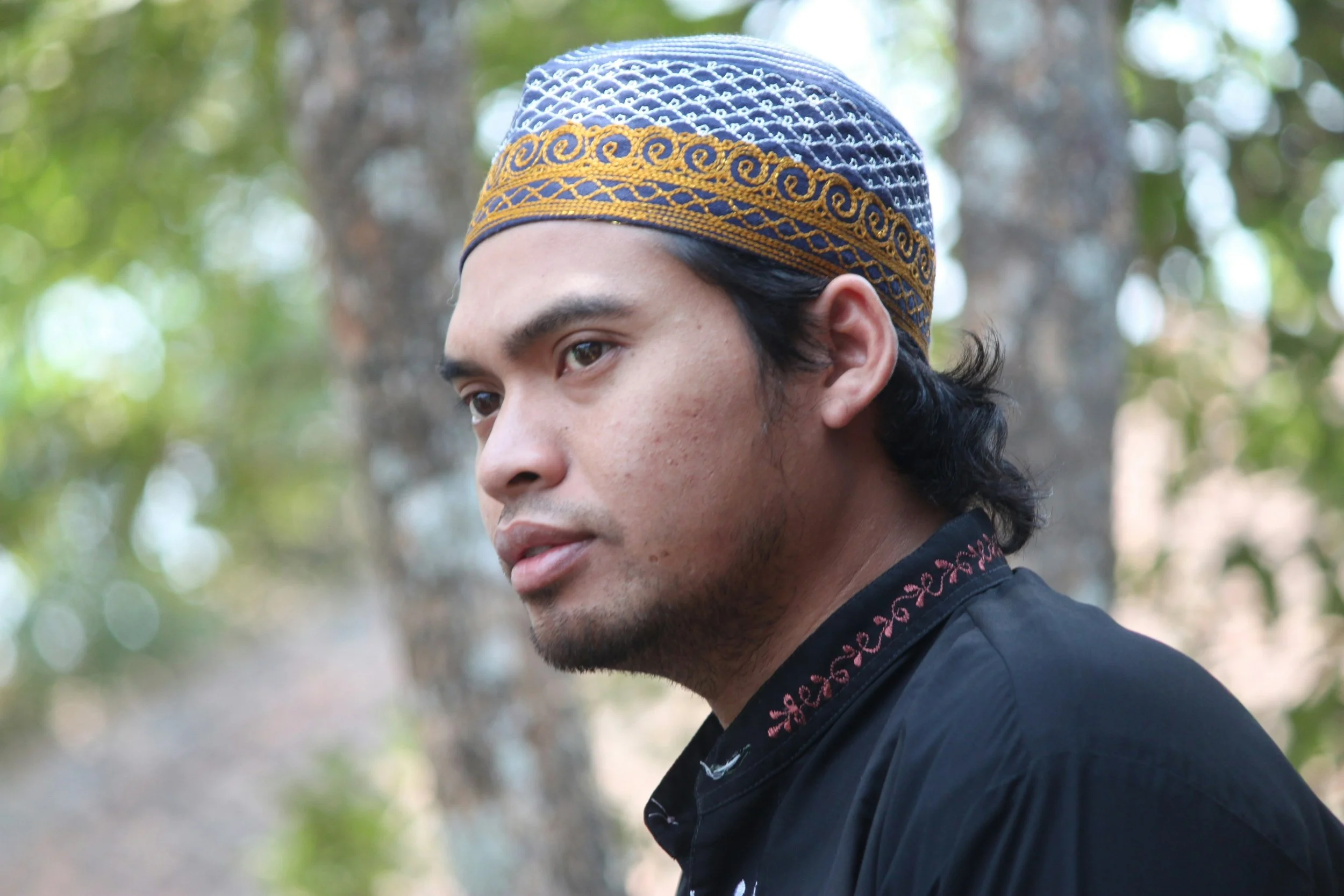
Portrait of a Filipino Muslim man looking into the distance. Photo by Mufid Majnun on Unsplash
You've sent Eid greetings in Arabic to one group chat and in Tagalog to another, and you wonder, not for the first time, which one actually feels like home.
If this sounds familiar, you may be navigating something that doesn't have a lot of space in mainstream conversations about Filipino identity, or in mainstream conversations about Muslim identity: the experience of being both.
Being Filipino and Muslim in the diaspora often means existing in the margins of two communities. In Filipino spaces, your faith may be treated as unusual, a deviation from the default. In Muslim spaces, your ethnicity may be overlooked, absorbed into a broader pan-Asian or Arab-centric narrative that doesn't quite include you. And in Canadian spaces, you may face the compounding weight of being a visible minority whose specific story is largely invisible.
Eid al-Fitr, the celebration marking the end of Ramadan, is a time of joy, gratitude, and community. This year, we want to hold space for Filipino Muslims who may be celebrating with a complicated mix of those feelings alongside questions about identity, belonging, and what it means to finally feel seen.
Islam Was Here Before the Cross
Here is something that does not get said often enough: Filipino Muslim identity is not a contradiction, and it is not new. Islam arrived in the Philippine archipelago more than a century before Spanish colonization, and Muslim communities were already governing, trading, and building long before any colonial account of Filipino identity was written. This history is documented and it is real, and if you were never taught it, that absence itself is worth sitting with.
We are not historians, and it is not our place to tell that story in full. What we can speak to is what it feels like to grow up without it.
For many Filipino Muslims, there is a particular kind of disorientation that comes from belonging to a history that has been largely erased from the version of Filipino identity most of us inherited. When the story you were taught about your own people does not include you, or includes you only as a footnote, it can quietly shape how legitimate you feel in your own identity. Research on colonized communities suggests that this kind of historical erasure is not just a matter of missing information. It can affect how people see themselves, how much they feel they belong, and how they relate to their own cultural roots (David & Okazaki, 2006, Cultural Diversity and Ethnic Minority Psychology).
The Double Erasure in the Diaspora
Landing in Canada does not resolve the in-between. For many Filipino Muslims, it deepens it.
Filipinos as a whole are already among the least visible of Canada's largest immigrant communities, a dynamic that researchers have described as a "disturbing invisibility" given how many Filipinos there are here and how rarely their specific stories appear in public life (Coloma et al., 2012, Filipinos in Canada: Disturbing Invisibility, University of Toronto Press). Filipino Muslims sit inside that invisibility with an added layer.
In Filipino-Canadian spaces, the unspoken cultural default is often Catholic, or at least Christian. If your faith comes up, it may land as surprising, as something that needs explaining, or as a source of quiet discomfort rooted in divisions that have been carried across the ocean. You may have felt the unspoken suggestion that being Muslim is somehow at odds with being Filipino, rather than part of the same long, braided history.
In Muslim community spaces in Canada, something similar can happen from the other direction. The shared cultural touchstones tend to skew Arab or South Asian. Your sinigang, your Tagalog, your particular way of being Muslim shaped by a Filipino upbringing, may sit at the edges of what people assume Muslim identity looks like.
Research on Muslim minority communities in diaspora contexts suggests that holding both a strong ethnic identity and a strong religious identity is associated with better mental health and wellbeing, but that it is significantly harder to sustain in environments that treat those identities as incompatible (Jugert et al., 2019, Journal of Youth and Adolescence). Which is to say: the exhaustion you may feel navigating all of this is not a personal failing. It is a reasonable response to being asked, over and over, to be less than the whole of who you are.
What Erasure Does to the Mind and Body
Identity is not abstract. When it is denied, fragmented, or rendered invisible, the effects are real and they show up in your body, your relationships, and your sense of self.
Colonial mentality research among Filipino Americans documents how the internalization of colonial narratives, including the devaluing of pre-colonial Filipino culture and history, is significantly associated with negative mental health outcomes including depression and lower self-esteem (David & Okazaki, 2006, The Colonial Context of Filipino American Immigrants' Psychological Experiences, Cultural Diversity and Ethnic Minority Psychology). For Filipino Muslims, colonial mentality may carry an additional dimension: absorbing not only the broader Filipino colonial narrative but also the specific devaluation of Islamic Filipino history and identity.
Research on ethnic identity among colonized communities shows that a strong connection to cultural heritage, specifically ethnic identity understood as "a sense of belonging based on one's ancestry, cultural heritage, values, traditions, rituals and often language and religion," may serve as a protective factor against the psychological impacts of discrimination and marginalization (Green et al., 2015, as cited in colonial mentality research, ResearchGate). When that heritage has been systematically erased, rebuilding that connection becomes an act of both cultural recovery and mental health care.
The experience of being a minority within a minority also carries its own weight. Filipino Muslim immigrants in Canada may navigate what researchers describe as compounding layers of marginalized identity, each carrying its own set of social stressors, microaggressions, and barriers to belonging (Chan & Litam, 2021, Mental Health Equity of Filipino Communities in COVID-19, The Professional Counselor). This is not a small thing to carry.
And it is worth naming that for many Filipino Muslims, the month of Ramadan itself may be a period of additional complexity. The spiritual practice of fasting and heightened devotion, deeply meaningful on its own terms, takes place in a broader Canadian context that largely does not recognize it, alongside a Filipino-Canadian community context that may not fully recognize it either. The energy required to hold your faith privately while navigating environments not designed for it is a real cost, and it often goes unacknowledged.
You Can Be Both. You Always Have Been.
The idea that Filipino Muslim identity is somehow contradictory, or less authentically Filipino, did not emerge on its own. It was constructed, deliberately, through centuries of colonial policy that needed Muslims to be cast as outsiders in their own homeland. That framing was never the truth. It was a strategy. And strategies, once named, begin to lose their hold.
Filipino and Muslim has never been a contradiction. For over 600 years, Muslim communities have been part of the Filipino story. The Tausug, Maranao, Maguindanao, and other Muslim ethnic groups did not arrive after the Philippines was formed. They were there at the formation, and long before it. Their resistance to colonization, their sultanates, their literature, their languages, are as Filipino as any other part of the archipelago's history.
In the diaspora, holding a Filipino Muslim identity may mean actively reclaiming this history, not because you owe anyone proof of legitimacy, but because knowing where you come from has a way of settling something in the self. Research on Filipino Americans suggests that learning about pre-colonial Filipino history and traditions, and sharing it intergenerationally, may serve as a protective factor against colonial mentality and may strengthen ethnic identity as a buffer against discrimination (Woo et al., 2020, as cited in scale validation research, PMC).
You can deeply value your faith and your Filipino roots. You can grieve the history that was taken from both, and you can celebrate what survived. You can find community in Filipino spaces and Muslim spaces, and you can name it clearly when neither fully holds you.
These are not either/or choices. They never were.
Finding Your Way to Both
If you are a Filipino Muslim navigating the diaspora, here are some ways to tend to yourself, particularly in this season of Eid:
Let yourself be the whole thing, if you want and at your own pace. You do not need to emphasize one identity to be accepted in the other. If a community or relationship requires you to flatten yourself to fit, that is information about the space, not about you.
Seek out Filipino Muslim community when you can. The Filipino Muslim diaspora in Canada is small but it exists. Online communities, local Muslim student associations, and organizations serving Filipino communities may offer spaces where both parts of you are recognized at once.
Learn the history you weren't taught. Reading about the Sultanate of Sulu, the Bangsamoro, the Maranao epic Darangen, or any part of the rich pre-colonial Islamic Filipino tradition can be quietly powerful. It is a way of telling yourself: this has always been part of who we are.
Name the exhaustion of constant translation. If you are tired of explaining yourself in every space you enter, that tiredness is valid. It is not weakness. It is the natural result of carrying something heavy with very little support.
Consider therapy that understands cultural complexity. Identity fragmentation and the mental health impacts of erasure are real clinical concerns. Working with a therapist who understands Filipino cultural experience, including its diversity, can create a space where you do not have to translate yourself before you begin.
Eid Mubarak, Kababayan
To every Filipino Muslim reading this, in Toronto, across Canada, and beyond: Eid Mubarak. Maligayang pagbati sa inyong lahat.
Your identity is not a compromise. It belongs to you, and it always has.
This Eid, may you find community that holds all of you. May the meal carry both the flavors of your homeland and your faith. And may you know, in whatever way feels true, that you have always belonged.
If you are navigating questions of identity, belonging, or the mental health impacts of cultural erasure, Larô Therapy offers culturally responsive care for Filipino adults. We would be honoured to walk that path with you. Book a Mutual Fit Call to get started.
This content is for informational purposes only and is not a substitute for professional mental health support.
References:
Chan, D. C., & Litam, S. D. A. (2021). Mental health equity of Filipino communities in COVID-19: A framework for practice and advocacy. The Professional Counselor, 11(1), 73–85. http://tpcjournal.nbcc.org
Coloma, R. S., McElhinny, B., Tungohan, E., Catungal, J. P. C., & Davidson, L. M. (Eds.). (2012). Filipinos in Canada: Disturbing invisibility. University of Toronto Press. https://doi.org/10.3138/9781442662728
David, E. J. R., & Okazaki, S. (2006). The Colonial Mentality Scale (CMS) for Filipino Americans: Scale construction and psychological implications. Journal of Counseling Psychology, 53(2), 241–252. https://doi.org/10.1037/0022-0167.53.2.241
Erasiah et al. (2023). A historical overview of Muslim minority identity and positioning in the Philippines. Tsaqofah, 19(1). https://jurnal.uinbanten.ac.id/index.php/tsaqofah/article/view/7966
Jugert, P., Noack, P., & Rutland, A. (2019). Dual identity development and adjustment in Muslim minority adolescents. Journal of Youth and Adolescence, 48(12), 2299–2314. https://doi.org/10.1007/s10964-019-01117-9
Macapagal, M. E. J., Montiel, C. J., & Canuday, J. J. P. (2018). The unifying and divisive effects of social identities: Religious and ethnopolitical identities among Mindanao Muslims in the Philippines. Journal of Pacific Rim Psychology, 12, e18. https://doi.org/10.1017/prp.2018.16
National Commission for Culture and the Arts (NCCA). (2015). The history of the Muslim in the Philippines. https://ncca.gov.ph/about-ncca-3/subcommissions/subcommission-on-cultural-communities-and-traditional-arts-sccta/central-cultural-communities/the-history-of-the-muslim-in-the-philippines/
Susilo, D., Sugihartati, R., & Santos, R. R. T. (2023). Muslim minority in Manila: Ethnographical studies of minority expression on the archipelago. Al-Jami'ah: Journal of Islamic Studies, 61(2), 419–440. https://doi.org/10.14421/ajis.2023.612.419-440