
The Pressure Behind the Prosperity: Mental Health for Filipino-Chinese Individuals at Lunar New Year
Lunar New Year can bring a unique pressure for Filipino-Chinese individuals navigating dual cultural expectations around prosperity, success, and family obligation. When huat ah meets dapat, the performance of abundance can mask real financial anxiety and mental health struggles. We explore the intersection of Filipino and Chinese cultural values during CNY and offers strategies for honouring both heritages while protecting your wellbeing.
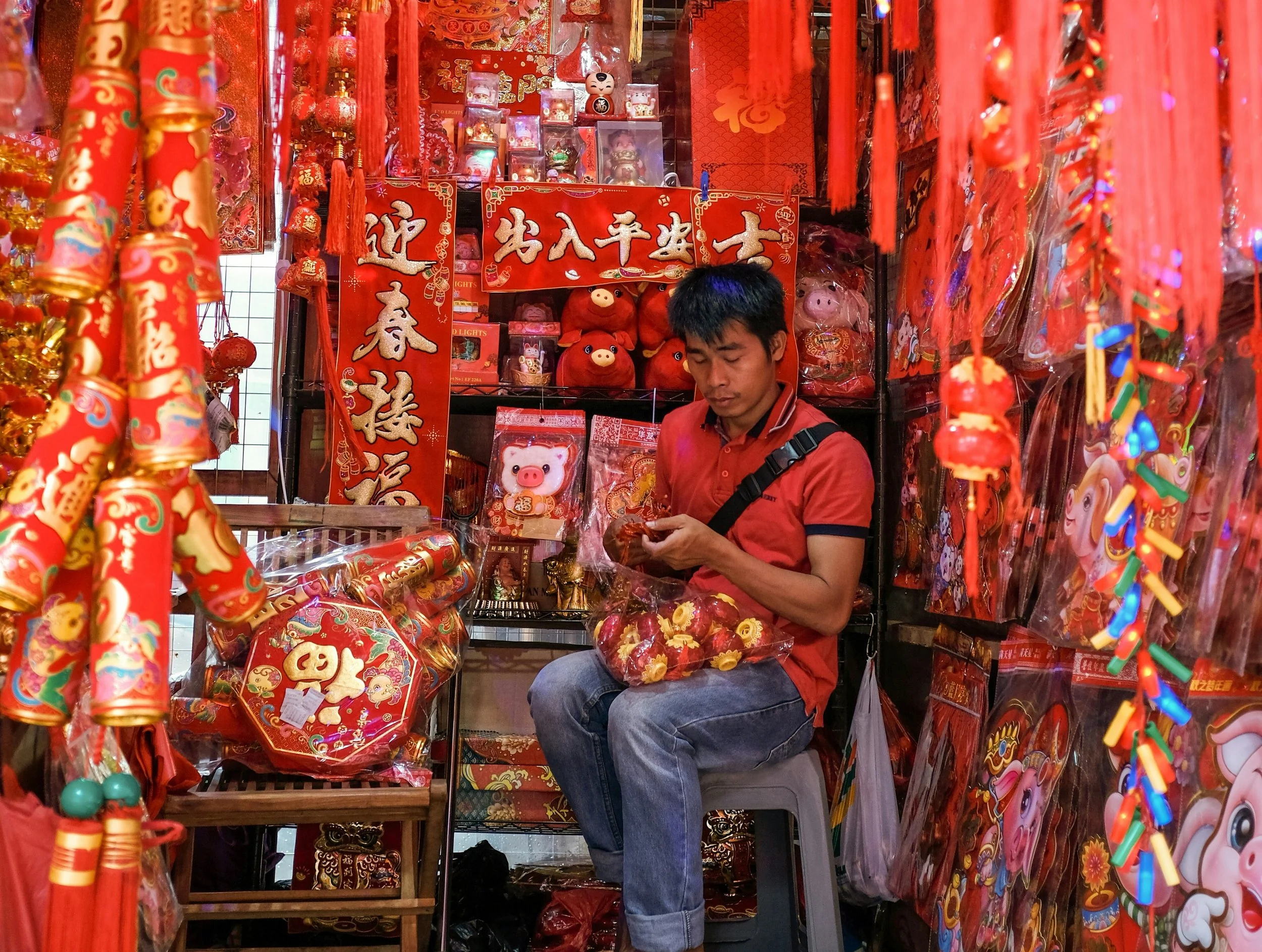
Shopkeeper in a store selling Lunar New Year lanterns and charms. Photo by Olivia Listyani
Everything looks red and gold and abundant.
The tables overflow with tikoy, oranges stacked in perfect pyramids, whole fish displayed with heads intact for luck. New clothes, fresh haircuts, ang pao envelopes ready to distribute. Laughter fills the room as family gathers, everyone looking prosperous and well.
But what happens when prosperity is the performance, not the reality?
In my work with Filipino-Chinese adults, this gap comes up every January and February. The space between how things look and how they actually feel. Between the abundance on display and the anxiety underneath. Between "huat ah" (prosper!) and the quiet panic about whether you're prosperous enough.
If you're reading this, you might know exactly what I mean.
What Prosperity Pressure Actually Looks Like
Lunar New Year centers prosperity in ways that go far beyond red decorations and lucky phrases. When family asks "huat ah?" or talks about 发财 (fā cái, getting rich), when the focus turns to swerte and who's doing well, the message is clear: success should be visible.
The mental load of this season might look like preparing how you'll appear at gatherings. What you'll wear to signal you're doing fine. What stories you'll tell about work that sound successful enough. What gifts you'll bring that communicate generosity without revealing struggle. How much you'll put in each ang pao envelope and what those amounts say about where you are in life.
For Filipino-Chinese individuals, this pressure gets compounded. You're navigating two cultural frameworks that both place high value on visible success, just in slightly different ways.
The Filipino context brings "dapat matagumpay na ako" (I should be successful by now) alongside expectations to support family financially. The Chinese context adds generational achievement narratives and 光宗耀祖 (guāng zōng yào zǔ), bringing honour to your ancestors through success. When these combine, the bar for "enough" can feel impossibly high.
Research on Asian American mental health shows that achievement pressure and the model minority myth create significant psychological burden, particularly around cultural celebrations that emphasize prosperity (Gupta et al., 2011). When your worth feels tied to visible success, struggling becomes not just difficult but unspeakable.
You can deeply value success AND feel crushed by the pressure to perform it constantly.
The Financial Anxiety
Let's talk about ang pao.
Those red envelopes represent far more than money. They communicate luck, yes, but also status and care and proof that you're doing well enough to be generous. The amount you give signals where you are in life, and everyone knows it.
The calculations might start weeks before Lunar New Year. How much is appropriate for your nieces and nephews? What about your younger cousins? Do you match what your siblings give, or does your age or career stage mean you should give more? What if you give less than last year? What will they think?
And the hardest question: what if you genuinely can't afford what feels "appropriate"?
The appearances equation extends beyond ang pao. New clothes signal prosperity, even when the credit card bill will hurt. The restaurant you choose for family dinner communicates your financial status. The gifts you bring, the stories you tell about recent purchases or travel plans, all of it builds a picture of someone who is doing well.
When you're actually struggling financially, Lunar New Year can feel like an elaborate performance you can't afford to give. The choice becomes: be authentic about your situation and face the shame, or maintain appearances and deal with the financial consequences later.
This is where "nakakahiya" meets "丢脸" (diū liǎn, losing face). Shame in a Filipino context around not meeting family obligations. Shame in a Chinese context around not maintaining family honour. The double bind makes silence feel like the only option, even as the stress builds.
Research shows that financial stress significantly impacts psychological wellbeing, and this effect is intensified when cultural factors prevent help-seeking or honest communication about struggle (Drentea & Lavrakas, 2000). When two cultural frameworks both treat financial difficulty as shameful, the isolation deepens.
Ang pao can be a genuine expression of care and blessing AND a source of significant anxiety. Both things can be true.
The Success Stories Nobody Tells
The questions start as soon as you arrive.
"Ano na trabaho mo?" (What's your job now?) "Kumusta ang business?" (How's business?) "Still with the same company?" The inquiries sound casual, but they're gathering data. Comparing you to your siblings, your cousins, to where you "should" be by this age.
Every family gathering has someone who's doing exceptionally well, the cousin or sibling everyone holds up as the success story. Their achievements become the informal benchmark, the proof of what's possible if you just work hard enough.
The model minority myth intensifies this. There's an assumption baked into these conversations that you are doing well, that success is the baseline for Filipino-Chinese individuals. When you're not thriving, when you're struggling or uncertain or between jobs or building something that hasn't paid off yet, it can feel like personal failure and cultural betrayal at once.
The competing narratives run simultaneously. "I should be supporting my family financially by now" meets "I should be building generational wealth." Both expectations, limited resources, and the sense that everyone else has figured out how to do both.
What makes this particularly isolating is that everyone performs success at these gatherings. You see prosperity and hear achievement stories and assume you're the only one struggling. The truth is that many people are performing too, but the performance is so convincing that it reinforces the isolation.
You can be genuinely proud of your path AND still feel the weight of others' expectations. These aren't mutually exclusive.
When Two Cultures Define "Enough" Differently
Here's what makes the Filipino-Chinese experience particularly complex: you're navigating two sets of cultural values that sometimes align and sometimes pull in different directions.
The Filipino framework emphasizes supporting family, being mabait (kind/good), maintaining pakikisama (smooth interpersonal relationships), and honouring utang na loob (debt of gratitude). Success includes but isn't limited to financial achievement. It's also about being present, being generous, being someone the family can count on.
The Chinese framework places high value on financial success, educational achievement, upward mobility, and 面子 (miànzi, face). Prosperity isn't just personal. It reflects on your entire family, your ancestors, your lineage.
When you try to be "enough" for both frameworks simultaneously, the math becomes impossible. How do you be financially generous enough to honour utang na loob while also building the kind of wealth that brings honour to your family name? How do you show up for every family obligation (pakikisama) while also focusing on the career advancement that both cultures value?
The language around struggle makes this harder. Hiya operates in Filipino contexts, that particular shame around not meeting expectations or causing family difficulty. 丢脸 (diū liǎn) operates in Chinese contexts, the shame of losing face or bringing dishonour. When you're struggling in any way, you're potentially violating both cultural frameworks. The silence feels protective, even as it isolates you.
Research on bicultural identity shows that navigating multiple cultural frameworks can create psychological stress, particularly when cultural values conflict or when there's pressure to demonstrate belonging through achievement (Benet-Martínez & Haritatos, 2005).
The hidden question underneath all of this: if I'm not visibly prosperous, do I still belong?
Your worth isn't measured by either culture's metrics. You can honour both heritages without meeting every expectation from each.
What Your Body Might Be Telling You
Pay attention to what happens in your body as Lunar New Year approaches.
You might notice tension building in your shoulders and neck in the weeks before family gatherings. Your stomach might feel unsettled when you think about upcoming celebrations. Sleep might become difficult in January and February, your mind running through calculations and conversations and worst-case scenarios.
Some people find themselves becoming hypervigilant about money and appearance, mentally tracking every expense, every comparison, every potential judgment. The anxiety isn't abstract. It shows up physically.
This happens because your nervous system is responding to real pressure. When cultural expectations create genuine stress, your body registers that as a threat. The anticipatory anxiety can start weeks before the actual celebrations, building as the date gets closer.
Research on cultural stress shows that navigating competing cultural demands creates measurable physiological responses (Ryder & Chentsova-Dutton, 2012). Your body isn't overreacting. The pressure is real, and your system is responding accordingly.
If you find yourself dreading Lunar New Year despite genuinely caring about your family, if the thought of upcoming gatherings creates physical tension, that's information worth paying attention to.
Practical Strategies
These strategies aren't about rejecting your culture or distancing yourself from family. They're about creating enough space so you can show up in ways that feel sustainable rather than depleting.
Redefine Prosperity for Yourself
Before the Lunar New Year season begins, take time to write down what prosperity actually means to you. Not what your family thinks it should mean, not what either cultural framework says it has to look like. What does "enough" mean in your actual life?
For some people, prosperity might mean peace of mind rather than a specific salary. It might mean meaningful work even if it's not prestigious. It might mean strong relationships, good health, time for rest, creative fulfillment, or simply feeling stable.
Separate your family's definition of success from your own values. Notice where they align and where they don't. Both can be valid. The question is which definition you're going to organize your life around.
This isn't about dismissing cultural values. You can value financial stability AND not perform wealth you don't have. You can respect the importance of prosperity AND define it in ways that fit your life.
Write it down. When the pressure builds during CNY, having your own definition written somewhere you can return to helps you remember what you're actually working toward.
Set Your Financial Boundaries Early
In November or December, before the season intensifies, calculate realistic ang pao amounts based on your actual finances. Not what you wish you could give, not what you think you "should" give based on your age or others' expectations. What you can actually afford without creating financial stress.
Decide these numbers ahead of time so you're not making anxiety-driven decisions in the moment. Practice the phrase "This is what I can do this year" until it feels possible to say out loud if needed.
Prepare simple responses for financial questions:
"I'm being thoughtful about money right now"
"I'm focusing on long-term stability"
"I'm making choices that work for my situation"
These aren't lies. They're boundaries. You're allowed to give smaller ang pao than family might expect. You're allowed to prioritize your own financial health over maintaining certain appearances.
Permission: You can love your family, honour the tradition of ang pao, AND give amounts that don't hurt you financially. These aren't in conflict.
Prepare Your Success Narrative
Family gatherings will include career questions. Prepare responses ahead of time that are honest and boundaried.
Instead of oversharing details or making up achievements, try:
"I'm focusing on work-life balance this year"
"I'm building something meaningful, it's a process"
"I'm proud of where I'm at, still figuring out next steps"
"Things are good, how are things with you?" (redirect)
Practice these with someone safe before the actual gathering. The goal isn't to perform fake success. It's to answer truthfully without revealing more than you want to share or inviting comparison.
You don't owe anyone your complete career update. You don't have to justify your path or prove you're "successful enough." Brief, kind answers are sufficient.
If someone pushes for more details, you can repeat your initial response or change the subject. "Like I said, focusing on balance. Hey, how's your work going?"
Find the Meaningful in the Ritual
Before CNY, ask yourself: what parts of Lunar New Year actually nourish you? What feels genuinely connective versus performative?
Maybe you love the food but dread the career conversations. Maybe you enjoy time with younger cousins but find the success comparisons exhausting. Maybe certain rituals feel meaningful while others feel hollow.
You're allowed to participate in the parts that matter to you and skip or modify the parts that don't. You can make tikoy with your own twist. You can attend one gathering but not all of them. You can engage with traditions in ways that feel authentic rather than obligatory.
This isn't disrespecting culture. Cultural traditions evolve. Each generation creates their own relationship with inherited practices while keeping what matters. You can honour both your Filipino and Chinese heritage AND adapt traditions for your life.
Build Your Support System
Find people who understand this specific intersection. Other Filipino-Chinese folks navigating the same dual cultural expectations. Friends who won't judge your choices around family gatherings or ang pao amounts.
Online communities can provide validation when you feel alone in this. Knowing that others are working through the same tensions, making similar difficult choices, struggling with the same impossible standards can reduce the isolation.
You need people you can be honest with about the pressure. People who understand why Lunar New Year brings anxiety alongside celebration. People who get that you can love your family and also need breaks from gatherings.
If You're Just Surviving This CNY
Some years, surviving is the actual win.
If you're reading this and thinking "I can't do any of these strategies right now," that's okay. If you're in crisis mode, if you're barely keeping things together, if the idea of setting boundaries or redefining prosperity feels impossible, you're not failing.
Harm reduction approach: what's the absolute minimum you need to do to get through this season?
Maybe that's:
Showing up for one gathering, not all of them
Giving smaller ang pao than you think you "should"
Leaving early when you need to
Saying no to some invitations
Asking someone safe to run interference during difficult conversations
This doesn't mean you're bad at culture or bad at family. It means you're triaging. You're doing what you can with what you have.
You can love your family AND need space from gatherings right now. You can value both heritages AND not have energy to navigate dual expectations this year. These aren't contradictions.
Next year, you might try different strategies. This year, just get through.
You're Evolving, Not Abandoning
The Filipino-Chinese community carries particular pressures around prosperity, achievement, and family obligation. When Lunar New Year arrives, those pressures intensify. Everything you're feeling in response to that is valid.
Setting boundaries around ang pao amounts or career conversations isn't rejecting either culture. Creating your own definition of prosperity isn't dishonouring your ancestors. Taking care of your mental health during this season isn't abandoning your family.
Each generation creates their own relationship with inherited traditions while keeping what matters most. Cultural values aren't static. They evolve, and you're part of that evolution.
You're not alone in navigating this tension. Others are working through the same impossible standards, making similar difficult choices, trying to honour both heritages while protecting their wellbeing.
You can value family connection AND need boundaries. You can respect cultural emphasis on prosperity AND define success in your own terms. You can participate in Lunar New Year traditions AND adapt them for sustainability.
If you're ready to explore this with someone who understands cultural complexity, who won't ask you to choose between your wellbeing and your values, Larô Therapy offers culturally-responsive support for Filipino adults navigating exactly these tensions.
Book a Mutual Fit Call to learn more about how therapy can help you create space for both honouring your heritage and taking care of yourself.
References:
Benet-Martínez, V., & Haritatos, J. (2005). Bicultural identity integration (BII): Components and psychosocial antecedents. Journal of Personality, 73(4), 1015-1050. https://doi.org/10.1111/j.1467-6494.2005.00337.x
Drentea, P., & Lavrakas, P. J. (2000). Over the limit: The association among health, race and debt. Social Science & Medicine, 50(4), 517-529. https://doi.org/10.1016/S0277-9536(99)00298-1
Gupta, A., Szymanski, D. M., & Leong, F. T. L. (2011). The "model minority myth": Internalized racialism of positive stereotypes as correlates of psychological distress, and attitudes toward help-seeking. Asian American Journal of Psychology, 2(2), 101-114. https://doi.org/10.1037/a0024183
Ryder, A. G., & Chentsova-Dutton, Y. E. (2012). Depression in cultural context: "Chinese somatization," revisited. Psychiatric Clinics of North America, 35(1), 15-36. https://doi.org/10.1016/j.psc.2011.11.006
Disclaimer: This content is for general informational and educational purposes only and is not a substitute for professional mental health advice, diagnosis, or treatment. If you're experiencing a mental health crisis or need personalized support, please consult with a qualified mental health professional.