
‘Bakit Wala Ka Pang Asawa?' Surviving Intrusive Family Questions During the Holidays
The New Year brings fresh starts—and family gatherings where the same old questions resurface. Here's how to navigate Filipino family expectations in 2026 without losing yourself in the process.
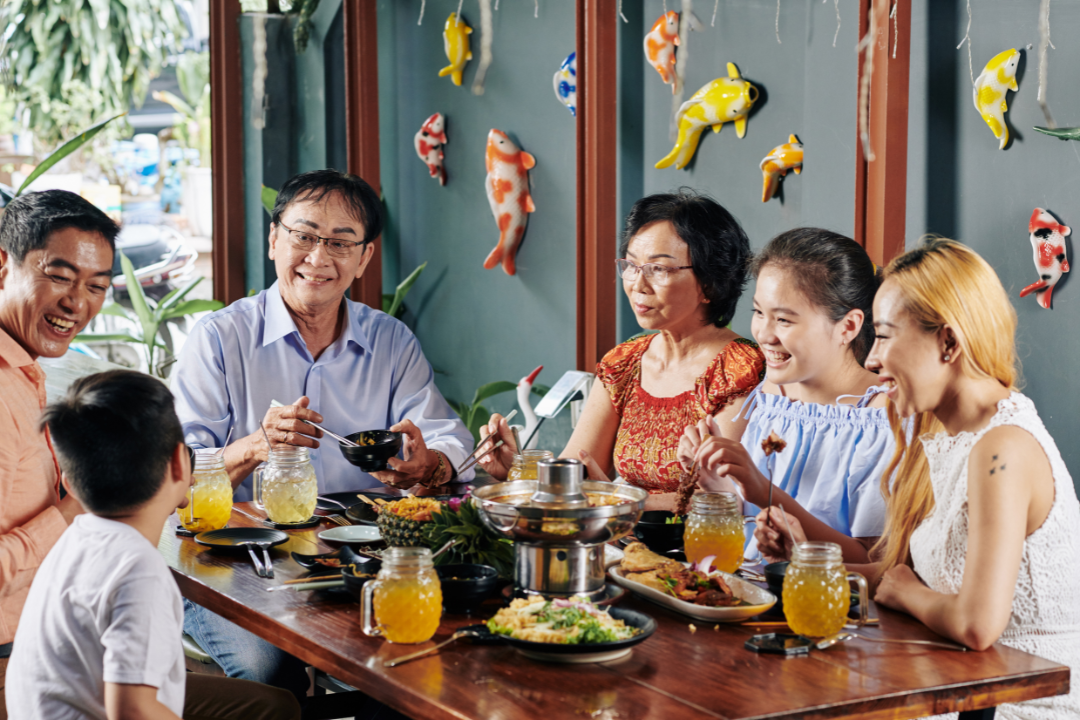
Happy big Asian family enjoying a meal together. Photo by @dragonimages for Canva Teams
The table is set. The media noche is ready. Your relatives are gathered to welcome 2026, and then it starts.
"Bakit wala ka pang asawa?" (Why don't you have a spouse yet?)
"Ano na plano mo this year?" (What are your plans this year?)
"Bakit wala ka pang anak?" (Why don't you have children?)
"Kailan ka mag-aasawa?" (When are you getting married?)
"Bakit hindi ka nag-doctor/nurse/engineer?" (Why didn't you become a doctor/nurse/engineer?)
If you're bracing yourself for family gatherings this New Year because of questions like these, you're not alone. We often hear this from Filipino students, young professionals, and adult learners who feel their stomachs tighten at the thought of these celebrations. Not because they don't love their families, but because they know what's coming.
The questions. The comparisons. The pressure to have your "New Year's resolutions" align with what your family wants. The feeling that nothing you've accomplished is ever quite enough.
Why These Questions Feel So Heavy
In many cultures, questions about personal life might feel nosy or rude. But in Filipino families, these questions often come from genuine care and concern—especially at the start of a new year when families are thinking about futures and possibilities. The challenge is that this care can feel like pressure, and that pressure can feel crushing.
Filipino culture is collectivistic. Research shows that Filipinos are "some of the most collectivistic people in the world" (David, 2011). We don't just care about ourselves, we're deeply connected to our families. Your life choices aren't seen as just yours; they reflect on the family as a whole.
This creates a unique dynamic where your marital status becomes family business, your career choice reflects on your parents' success, and your life timeline is measured against cultural expectations. New Year gatherings intensify this as families discuss plans, goals, and hopes for the coming year.
When Tita asks "Bakit wala ka pang asawa?" or "Ano na plano mo this year?", she's expressing concern based on cultural values about family and stability. But that doesn't make the question any less painful, especially if you're dealing with relationship struggles, questioning your path, or simply living life on a different timeline.
The 'Anak ng Kapitbahay' Comparison Trap
"Anak ng kapitbahay" (the neighbour's child) has become such a cultural phenomenon that many Filipinos joke about this mythical perfect child who does everything right.
But the comparison isn't funny when you're the one being compared—especially as everyone reflects on the past year and sets expectations for 2026.
"Si [name], may asawa na. May bahay na. Doctor pa. Ikaw?" (So-and-so is already married. Has a house. And is a doctor. What about you?)
These comparisons are meant to motivate, but research on social comparison shows they often have the opposite effect, leading to lower self-esteem, increased anxiety and depression, and decreased motivation (Festinger, 1954).
The painful irony is that your relatives likely don't realize how much these comparisons hurt. In their minds, they're simply expressing that they want good things for you in the new year. But the message you receive is: "You're not enough as you are."
What These Questions Really Cost You
Beyond the immediate discomfort, there's a deeper cost:
You learn to hide parts of yourself. If you're struggling with mental health, relationship issues, or career doubts, you learn quickly that these topics aren't "safe" to discuss. Research shows that emotional suppression is linked to higher rates of anxiety, depression, and physical health problems (Gross & John, 2003).
You internalize conditional worth. When family approval seems tied to specific milestones, you may start to believe your worth depends on achieving these things.
You lose touch with your own values. In trying to meet everyone else's expectations for your new year, you may lose sight of what you actually want for your life.
You feel guilty for wanting boundaries. Perhaps the most painful cost: feeling guilty for wanting to protect yourself. Many Filipino young adults struggle with the thought: "Why can't I just accept this? My family loves me—I should be grateful."
But wanting boundaries doesn't mean you're ungrateful. It means you're human.
Strategies That Actually Help
Let's be clear: We're not suggesting you cut off your family. What we are suggesting is that you can honour your family relationships and protect your wellbeing as you enter 2026. These aren't mutually exclusive.
1. Prepare Your Responses in Advance
Having prepared responses can help you feel less caught off-guard. The key is finding responses that feel authentic while gently redirecting the conversation.
For relationship status questions:
"I'm focusing on [school/career/personal growth] right now, and I'm happy with where I am."
"When it happens, it happens. I trust the timing of my life."
"I appreciate your concern. I'll share when there's news to share."
For New Year plans/goals questions:
"I have some personal goals I'm working on. I'm excited about this year."
"I'm taking things one step at a time. We'll see what 2026 brings."
For career/life path questions:
"I'm really proud of the work I'm doing, even if it's different from what we originally discussed."
"This path feels right for me. I hope you can support that."
For comparison questions:
"Everyone's timeline is different. I'm doing what's right for me."
"I'm happy for [person], and I'm also happy with my own journey."
The gentle deflection:
"Tell me about what's been happening with you instead?"
You don't owe anyone a detailed explanation of your life choices. Brief, kind, firm responses are perfectly acceptable.
2. Set Boundaries Before You Arrive
If possible, have conversations with key family members before gatherings:
"I'm really looking forward to celebrating the New Year together. I want to ask for your help with something: I'm going through a lot with [school/work/life] right now, and I'd appreciate it if we could avoid questions about [specific topic]. Can we focus on just enjoying time together instead?"
This won't work with everyone, but it might help with parents or siblings who can advocate for you.
3. Build Your Support System
Identify allies within your family—siblings, cousins, or younger relatives who "get it." Having someone you can exchange knowing glances with or take breaks with can make gatherings more bearable.
You can make a pact a cousin: whenever either of them received an uncomfortable question, the other would interrupt with an "emergency" need. Sometimes you need backup.
4. Practice the 'Grey Rock' Method
When questions become intrusive, you can become strategically uninteresting. Give brief, factual answers without emotion or detail:
"How's your love life?" "It's fine, thanks. How's the food?"
The goal isn't to be rude, but to be boring enough that the questioner loses interest and moves on.
5. Plan Your Exit Strategy
Give yourself permission to leave early or take breaks. You might volunteer to do errands, take "phone calls" that require you to step outside, or set a specific time you need to leave and stick to it.
You don't have to endure every minute of a gathering that's draining you. Brief breaks can help you reset.
6. Process Afterwards
After difficult family gatherings, make time to decompress. This might look like journaling, talking to a friend or therapist, physical activity, or doing something that affirms your own values and choices.
Don't minimize what you experienced. You're allowed to find these interactions difficult.
When Setting Boundaries Feels Impossible
We want to acknowledge something important: for many Filipino young adults, setting boundaries with family feels nearly impossible.
The cultural weight of "utang na loob" (debt of gratitude), the fear of being seen as "walang utang na loob" (ungrateful), and the genuine love you have for your family can make boundary-setting feel like betrayal.
You might think: "They sacrificed so much for me. The least I can do is answer their questions."
But here's what we've learned: sustainable family relationships require some boundaries. Without them, resentment builds. You start avoiding family gatherings. The relationship suffers anyway.
Setting boundaries isn't selfish. It's what allows you to show up for family relationships in a sustainable way.
You're Not Being 'Too Sensitive'
If you're thinking, "Maybe I'm just being too sensitive," I want to challenge that.
Cultural psychologists have documented how the collectivistic nature of Filipino culture, combined with high expectations and strong family interdependence, creates unique pressures (David, 2011). These pressures are real. The stress you feel is valid.
You're not weak for finding these interactions difficult. You're human.
Moving Forward in 2026: 'Unti-Unti' (Little by Little)
You don't have to transform your family dynamics overnight. Instead, try "unti-unti" (little by little):
This New Year, maybe you try one prepared response.
Next gathering, maybe you take one strategic break.
Over time, maybe you have one honest conversation with one family member.
Small changes, practiced consistently, create real shifts.
The New Year is meant to be about hope, connection, and fresh starts. You deserve to experience it that way, not as an interrogation or performance review.
Your life is yours to live. Your timeline is valid. Your choices are enough.
As you step into 2026, remember: You're doing well. You're enough. Exactly as you are.
If You Need Support
If you're a Filipino student or adult learner struggling with family expectations, cultural pressure, or finding your own path while honouring your family, we're here to help. Together, we can develop strategies for setting boundaries, managing anxiety around family gatherings, and building confidence in your own choices as you navigate 2026.
Book a free mutual fit call to explore how therapy can support you.
References
David, E. J. R. (2011). Filipino American postcolonial psychology: Oppression, colonial mentality, and decolonization. Bloomington, IN: AuthorHouse.
Festinger, L. (1954). A theory of social comparison processes. Human Relations, 7(2), 117-140. Doidoi.org/10.1177/001872675400700202
Gross, J. J., & John, O. P. (2003). Individual differences in two emotion regulation processes: Implications for affect, relationships, and well-being. Journal of Personality and Social Psychology, 85(2), 348-362. DoiAPA PsycNet